Prayer rhythm
Praying with Scripture: a beginner's guide to lectio divina
Lectio divina is an ancient, gentle way to pray with the Bible: read, reflect, respond, rest. Here is how to begin.
On this page
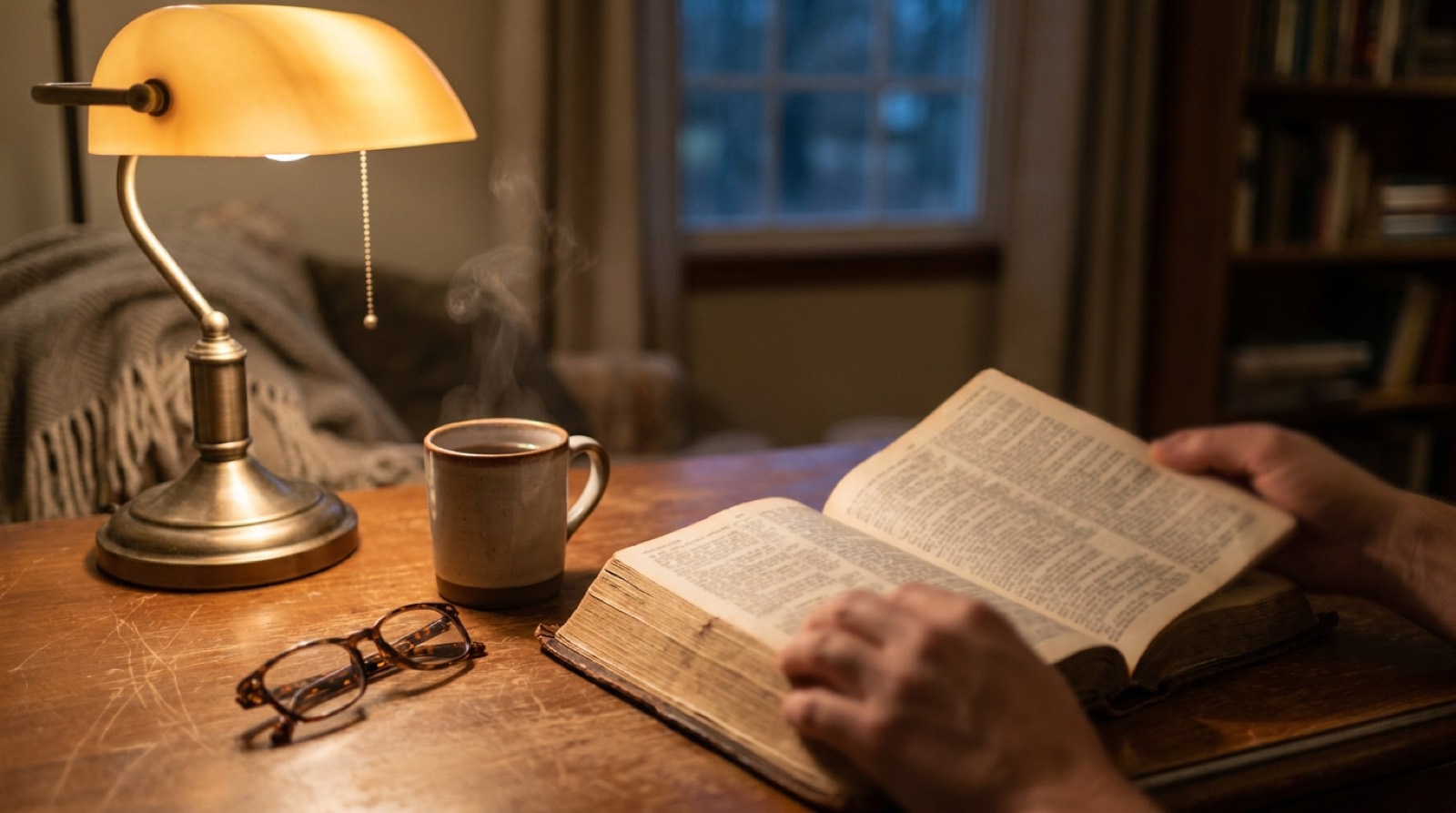
Praying with Scripture can feel like stepping into a quiet room you did not realize you were allowed to enter. You are used to reading fast, scanning for meaning, trying to remember what you learned. Lectio divina is an invitation to read differently, slowly enough to be met.
Reading the Bible as prayer, not homework
There is a kind of Bible reading that is mainly about information. You look for context, themes, definitions, timelines, and what the passage meant then. That kind of study can be deeply faithful, and it can strengthen your mind and your discernment.
But there is also a kind of Bible reading that is mainly about presence. You come with your real life in your hands, and you ask God to meet you in a few lines of text. Lectio divina, which means "divine reading," is not about getting through a chapter, it is about being with the Lord in a small portion of Scripture.
Your word is a lamp to my feet and a light to my path. (Psalm 119:105)
A lamp does not flood the whole landscape with light. It gives enough for the next step. When you pray with Scripture, you are not forcing clarity about everything, you are receiving guidance for what is in front of you.
Here is one gentle way to frame the difference:
- Study asks: What does this mean, and how does it fit into the whole story?
- Lectio asks: What is God saying to me here, today, and how am I being invited to respond?
- Study measures progress: pages covered, notes taken, concepts understood.
- Lectio measures faithfulness: returning, listening, and consenting to be loved and led.
If you have ever sat with a friend and realized you did not need to fill the silence, you already understand the spirit of lectio divina. It is relational. You are not trying to win at Bible reading. You are letting the Word read you.
A very old, very simple practice
Lectio divina has a long, quiet history. Christians have prayed this way for centuries, especially in monastic communities, where Scripture was received as daily bread rather than a textbook. The phrase "divine reading" hints at the posture: you read expecting God to be present, and you read with time.
Over time, teachers described the practice in a simple pattern, not as a rigid method, but as a trellis. In different places and eras, the details varied, yet the heart stayed the same: slow, listening reading that makes room for God.
but his delight is in the law of the Lord, and on his law he meditates day and night. (Psalm 1:2)
In Scripture, "meditates" does not mean emptying your mind. It means turning a verse over slowly, like chewing. It is the unhurried attention of love. You stay with a phrase long enough to notice its texture, its comfort, its edge, its invitation.
If you are new to this, it may help to hear what lectio divina is not:
- Not a test. You are not proving you are serious, spiritual, or disciplined enough.
- Not a race. You do not "cover" Scripture so much as let Scripture cover you.
- Not a trick for instant peace. Sometimes you will feel soothed, sometimes you will feel exposed, often you will feel ordinary.
- Not only for monks. This practice belongs to the whole church now, including you in your actual life, with your actual schedule.
There is something steadying about receiving a practice that has carried ordinary believers through ordinary days. You do not have to invent your own way to pray. You can simply join the stream.
The four movements
Lectio divina is often described in four movements. They are not strict steps you must complete perfectly. Think of them as movements of the heart that you return to again and again: reading, reflecting, responding, and resting.
If you only have five minutes, you can still touch each movement lightly. If you have twenty minutes, you can linger. Either way, the point is not to perform the method, it is to make space for encounter.
Read (lectio)
Start small. Choose a short passage, just a few verses, even one paragraph. A Psalm or a scene from the Gospels works well because the language is vivid and direct.
Read it slowly, even aloud if you can. Read it two or three times. On the first reading, you are simply receiving the words. On the second, you may begin to notice tone, repetition, or an image. On the third, you might sense a particular phrase asking you to stop.
A few practical helps:
- Keep it short. If you choose too much, your mind shifts into "finish the assignment" mode.
- Read with your body. Sit comfortably, breathe a little deeper, unclench your jaw, let your shoulders drop.
- Let it be simple. You are not hunting for hidden meaning, you are listening.
If it helps, you can begin with a quiet sentence like, "Lord, I am here." Not to impress God, but to locate yourself. You are moving from noise to attention.
Reflect (meditatio)
In reflection, you notice what stands out. It might be a single word that feels warm or sharp. It might be a phrase that seems to repeat in your mind. It might be a detail you have never noticed before.
You do not have to force this. Often the "standing out" is gentle, almost shy. Your job is to honor it with attention. Sit with that word or phrase and ask, with curiosity, "Why is this drawing me today?"
For the word of God is living and active, sharper than any two-edged sword. (Hebrews 4:12)
Sometimes the Word comforts. Sometimes it clarifies. Sometimes it exposes a fear you have been avoiding, or names a desire you have been hiding from yourself. "Living and active" means you are not reading a relic. You are meeting a voice that knows how to reach you.
Here are a few questions you can hold lightly, one at a time:
- What word or phrase is shimmering for me right now?
- What feeling rises as I sit with it (peace, resistance, hope, grief)?
- What does this touch in my life today (a relationship, a decision, a wound, a habit)?
- What might God be offering me here (comfort, correction, courage, patience)?
Try to stay with the text itself. Reflection is not daydreaming. It is a slow attention to the words, and to your honest inner response.
If your mind wanders, that does not mean you are doing it wrong. Wandering is part of being human. Gently return to the phrase, like guiding a small child back to the path. No scolding, no drama, just returning.
Respond (oratio)
Response is where the reading becomes prayer in your own words. You speak to God about what surfaced. This is not the time to sound polished. It is the time to be real.
Sometimes your response will be gratitude: "Thank you for seeing me." Sometimes confession: "I have been holding tight to control." Sometimes request: "Give me patience with my family tonight." Sometimes longing: "I want to trust you, help my unbelief." Your prayer can be as short as a sentence.
A few simple forms of response that can help when you are unsure what to say:
- Thanks: "Thank you for..."
- Help: "Lord, I need..."
- Truth: "I admit that I..."
- Surrender: "I release..."
- Ask: "Please give..."
- Intercede: "Be near to..."
You do not have to fix yourself before you pray. If the Word reveals something tender, you can bring that tenderness directly to God. If it reveals something hard, you can bring the hardness, too. Prayer is not the reward for being better, it is the place where you are met.
Rest (contemplatio)
After you have spoken, you stop. Not because you have run out of things to say, but because love does not always need words. Rest is the movement of simply being with God for a moment.
This can be the simplest part and also the hardest. Your mind may want to evaluate the experience: Did I do it right? Did I feel anything? Did I get a takeaway? When that happens, you can return to quiet presence, without wrestling.
In this resting, you let the word settle. You do not squeeze it for results. You trust that God can work in you below the surface, like seed in soil.
A few gentle ways to practice contemplatio:
- Sit in silence for 30 to 60 seconds. If that feels impossible, start with 15 seconds.
- Hold the phrase again. Repeat it slowly, once or twice, like a lullaby.
- Breathe a simple prayer. Inhale: "Here I am." Exhale: "Have mercy." (Or any brief words that help you stay present.)
Rest is not emptiness. It is attentiveness without striving. It is giving God room to love you without your constant effort.
How to begin this week
You do not need a perfect plan. You need a small, repeatable rhythm that fits your life. Lectio divina is less like a heroic sprint and more like a daily walk around the neighborhood. What matters is returning.
Here is a simple way to begin, just for this week:
- Pick a passage: choose a Psalm or a short Gospel passage, something you can read in under a minute.
- Set 5 to 10 minutes: enough time to slow down, not so much that you avoid it.
- Choose the same time and place: a chair by the window, the edge of your bed, a parked car before work, the kitchen table before everyone wakes.
- Expect a wandering mind: when you notice you have drifted, return gently to the words.
- Keep it short: stop while it still feels doable, so you will want to come back tomorrow.
If you would like a concrete structure, you can try this:
- Minute 1: breathe, read the passage once.
- Minutes 2 to 4: read again, notice a word or phrase, sit with it.
- Minutes 5 to 7: respond to God in your own words.
- Minutes 8 to 10: rest quietly, repeat the phrase once more, then close with "Amen."
It can also help to choose one passage and stay with it for several days. The first day you notice the obvious. The second day you notice the tender. The third day you notice the part you had been skipping. Repetition is not boring here. It is how Scripture becomes familiar enough to speak.
If you like journaling, keep it light. One or two lines is enough:
- The phrase I noticed:
- What it touched in me:
- My simple prayer:
But journaling is not required. Some seasons call for writing. Other seasons call for simply showing up.
Most of all, be reassured: there is no failing at this. You are not graded on focus, emotion, or insight. Presence matters more than performance. If you sat down, opened Scripture, and returned your attention a few times, you prayed.
And if all you can manage is to read one verse and whisper, "God, I'm tired," that counts. In fact, it may be the truest prayer you have.
How Sellah helps
Lectio divina is simple, but it asks for something rare: unhurried attention. The hard part is often not the reading, it is the interruptions, the reflex to check, the feeling that you should be doing something else. You do not need to punish yourself for that. You can build a small kindness into your day that makes room for prayer.
Sellah is designed to support that kind of gentle space. Because it uses your phone's own Screen Time and focus tools, it can be a fence, not a cage. Calls always come through, and you can end a pause anytime.
Here are a few ways it can support your practice this week:
- A small pause for slow reading: Sellah can gently pause your most distracting apps at the time you choose, so you can read without the constant tug to multitask.
- A short passage held in front of you: you can keep your Scripture brief and accessible, which makes it easier to read the same lines two or three times.
- A calm voice that slows you down: a steady, unhurried voice can read the words slowly, helping you listen for what stands out, and then making room for silence.
- A prompt to respond in your own words: after the reading, you can speak to God simply and honestly, without needing to craft a long prayer.
If distraction is the main battle for you, you might appreciate this gentle guide: how to focus when you pray. And if you are drawn to the final movement of rest, but do not know where to begin, these passages can be a steady companion: Bible verses about rest and stillness.
When you are ready, you can explore how to set up your own prayer pauses here: start here. Not to add pressure, but to make the next small step easier, so you can return to Scripture as prayer, again and again, with a little more quiet each time.
Frequently asked
Written by
Alex Melo
Founder of Sellah
Alex founded Sellah to help people make a sacred pause in a noisy world, pairing thoughtful technology with a life of prayer.
Keep reading

How to pray in the morning (a simple rhythm)
A gentle, repeatable way to give God the first minutes of your day, even on the busy ones. No guilt, no streaks to defend.

Fixed-hour prayer: an ancient rhythm for a distracted age
One of the oldest habits in the church: a few set moments a day to turn toward God, and why it still steadies a noisy life.
How to focus when you pray (and quiet a wandering mind)
A practical, grace-filled guide to praying with a wandering mind: why it happens, and gentle ways to come back to God.