Prayer rhythm
How to build a daily prayer habit that lasts
A gentle, realistic guide to making prayer a daily rhythm: start small, anchor it to your day, and keep returning.

On this page
A daily prayer habit does not have to feel like a cliff you keep trying to climb. It can be more like a well-worn path through your ordinary day, the kind your feet remember even when your mind is tired. You are not trying to become impressive, you are trying to become present.
What lasts is usually simple, humble, repeatable. And what grows is usually what you can return to without fear.
Why prayer habits fall apart
Most prayer habits do not collapse because you do not love God. They fall apart because you built them the way you build a New Year plan: big, inspiring, and dependent on a version of you who never gets sick, never gets interrupted, and never feels numb.
A few common ways it breaks:
- Too ambitious. You set out to pray for 45 minutes every day, journal three pages, read five chapters, and intercede for the nations, then life happens on day three.
- No fixed cue. You mean to pray "sometime today," which quietly becomes "not today," because nothing in your day actually catches and holds the intention.
- Running on willpower. You treat prayer like a moral test, then wonder why it feels heavy, especially when you are already carrying a lot.
- Quitting after one missed day. You miss once, then shame tells you the story: "See, you are not really the kind of person who prays," and you drift.
You have probably seen all of these in yourself, not because you are uniquely flawed, but because you are human. Habits, even holy ones, need mercy built into them.
pray without ceasing. (1 Thessalonians 5:17)
That line can sound impossible if you hear it as nonstop talking. But ceaseless prayer becomes possible through small, repeated returns, not heroic marathons. It is less like holding your breath all day, and more like breathing again and again, especially after you notice you have been holding it.
"Without ceasing" can look like this: a thousand gentle re-orientations. A habit that does not demand perfection, only a willingness to come back.
Start absurdly small
If you want a prayer habit that lasts, you begin by making it almost laughably doable. Not because prayer is small, but because you are building a doorway you can walk through every day, even on the days when you feel scraped thin.
Try starting with a minimum you can keep on your worst day:
- Begin with two minutes. Set a timer if it helps, not as a rule, but as a little container that keeps you from bargaining with yourself.
- One verse and one honest sentence. Read a single line of Scripture, then say one true thing to God about what is happening in you.
- You can always do more. When you have margin, you can linger, but the habit is built on the minimum.
- Make the minimum non-negotiably kind. It should be possible when you are tired, grieving, distracted, or traveling.
Two minutes may sound too small to "count," especially if you have a picture of prayer as something long and soaring. But small is not unspiritual, it is sustainable. God is not measuring your devotion by the length of your prayer, and you do not have to talk yourself into His attention.
A tiny practice also teaches you something important: prayer is not a performance you gear up for. It is a relationship you return to. Sometimes the holiest thing you can do is simply show up, even briefly, and tell the truth.
Here are a few examples of "one honest sentence" prayers that are plain enough to survive a hard day:
- "God, I feel scattered, please gather me."
- "Jesus, I am anxious, stay close."
- "Father, I do not know what I feel, help me notice."
- "Lord, I am grateful for this one small good thing."
If two minutes feels too easy, good. Easy is what you can repeat. Repetition is what becomes a rhythm, and rhythm is what becomes a home.
Anchor it to something you already do
A lasting habit usually needs a cue, something that tells your body, "Oh yes, this is the moment." If you try to pray in the abstract space of "whenever," you will keep depending on motivation, which is tender and unreliable.
Instead, attach prayer to a practice that already happens. You are not adding a whole new event, you are weaving prayer into the fabric that is already there.
Some anchors that work well:
- Coffee or tea. The first sip becomes the reminder, "Before I take in the day, I return to God."
- Commute. When you turn the key, start the train ride, or step out the door, you offer your day in simple words.
- After brushing your teeth. A small, steady cue, already tied to daily life.
- When you plug in your phone at night. The physical act of setting it down becomes a little liturgy of release.
- Right after lunch. A mid-day exhale, especially when the afternoon can feel long.
This is not about copying someone else's "ideal" schedule. It is about finding a hinge in your day, a place where a small turn is already happening.
And rising very early in the morning, while it was still dark, he departed and went out to a desolate place, and there he prayed. (Mark 1:35)
Jesus had a time and a place. Not because God is only available at dawn, but because embodied life needs practical patterns. The point is not that you must be a morning person, the point is that prayer becomes easier when it is anchored to something concrete.
You can make your own "desolate place," even if your life is noisy:
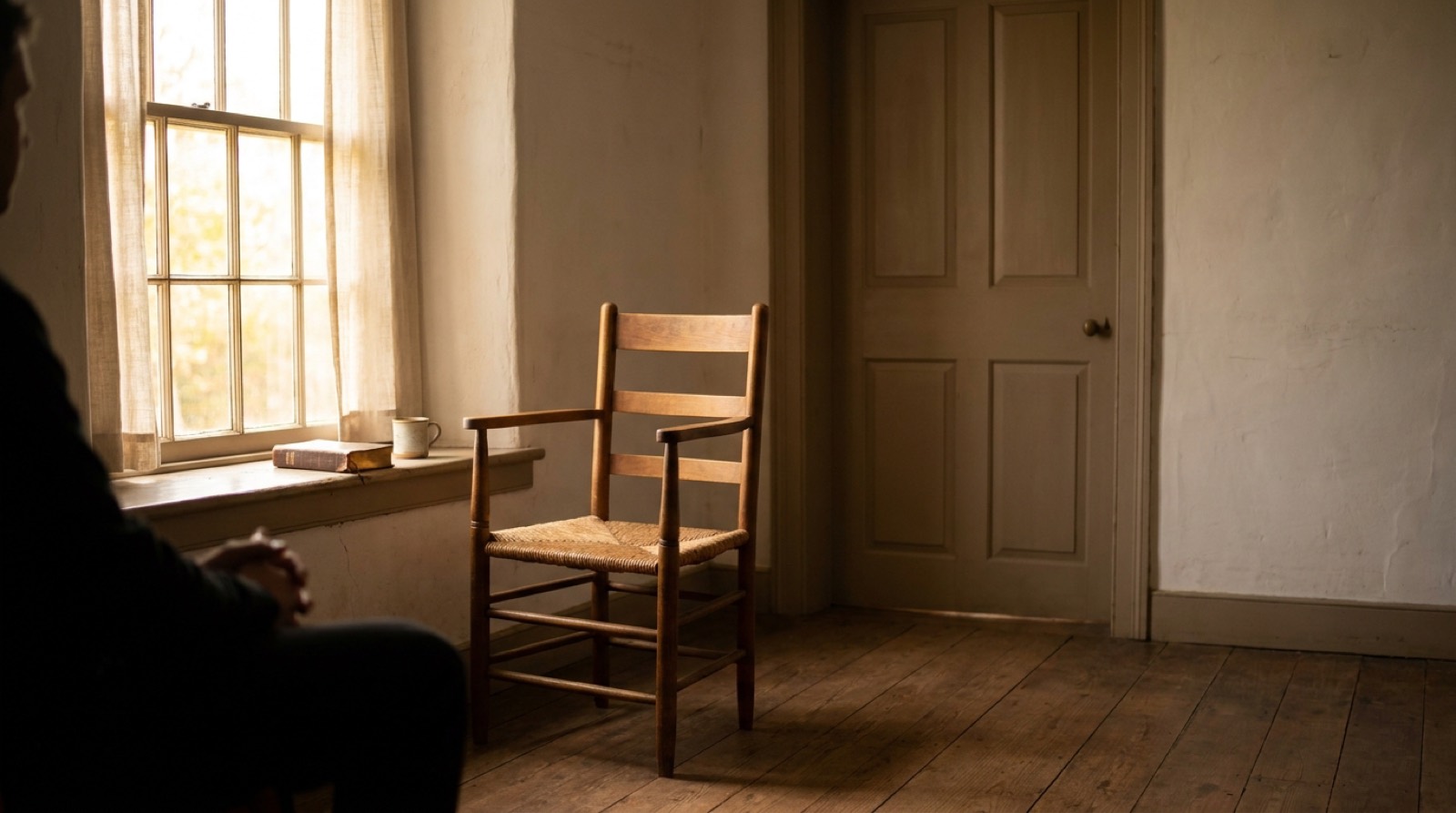
- A chair. The same chair, if possible, because your body will learn it.
- A corner of the couch. A small space that says, "Here I meet God."
- A short walk. A loop you can do in any weather, with a simple prayer as your companion.
- The car before you go inside. Two minutes of stillness before you become needed again.
When you anchor prayer, you reduce the daily negotiation. You do not have to decide if you will pray today, you simply arrive at the cue you always arrive at, and you take the next gentle step.
Give it a simple shape
Many people stop praying not because they do not want to, but because they do not know what to do once they sit down. The blankness can feel loud. A simple, repeatable shape removes daily decision fatigue.
You are not trying to manufacture spiritual feelings. You are giving yourself a path to walk when you feel nothing, when you feel too much, or when you feel distracted.
A simple four-part pattern can be enough:
- Quiet. One slow breath. Hands open. Shoulders down. You are not rushing God.
- A verse. Read a single verse slowly, maybe out loud. Let it be the first voice you hear.
- Your heart. Name what is true right now: joy, fear, numbness, gratitude, resentment, hope.
- A prayer. Ask for what you need, bless the people on your mind, surrender what you cannot carry.
If you want it even simpler, you can boil it down to three short movements:
- "Here I am." Presence.
- "This is what is real." Honesty.
- "Help me." Dependence.
The goal is not variety, it is steadiness. Variety can come later, like flowers that grow along a path you have already walked a hundred times.
Rejoice in hope, be patient in tribulation, be constant in prayer. (Romans 12:12)
"Be constant" does not mean "be dramatic." Constancy is quiet faithfulness. It is the decision to return, again and again, with a prayer that sounds like your life.
A few practical ways to keep the shape gentle:
- Keep tools visible. Leave your Bible where you sit, or keep a small list of names tucked inside.
- Use one short written prompt. Something like, "God, today I feel...," so you can begin even when your mind is foggy.
- End with one small act of trust. "I give You this meeting," or "I release this person," or "I receive Your peace."
You are learning a rhythm, not passing a test. And a rhythm becomes more natural the less you complicate it.
What to do with distraction
Distraction is not a sign you are failing, it is a sign you are alive in a busy world. When your mind wanders, you do not need to scold it. You can shepherd it.
Try a few simple responses:
- Name it gently. "I am thinking about that conversation."
- Write it down. A quick note on paper, not to indulge the thought, but to set it aside.
- Return to the verse. Read it again slowly, like you are coming back to shore.
Every return is prayer. Not the dramatic kind, but the faithful kind.
When your prayers feel dry
There will be seasons when prayer feels thin. Do not interpret dryness as absence. Often it is simply fatigue, grief, stress, or a soul that needs quiet more than words.
On dry days:
- Shorten the time, not the practice. Keep your two minutes.
- Tell God the truth about the dryness. Honest prayer is real prayer.
- Let the verse carry you. You do not have to generate warmth to be loved.
Dryness is not the end of a habit. Sometimes it is the soil where deeper roots form.
Expect to miss, and return without shame
If you plan to pray daily, you should plan to miss. Not because you are careless, but because you are human. People get sick. Babies wake up. Work explodes. Travel disrupts. Grief changes your capacity. Some days you simply forget.
The question is not whether you will miss, it is what you will do next.
And he told them a parable to the effect that they ought always to pray and not lose heart. (Luke 18:1)
"Not lose heart" matters here. Many prayer habits die not from busyness, but from the heavy feeling that comes after a missed day. Shame turns one missed prayer into a verdict about your whole life, and then it becomes easier to stop trying than to face the disappointment.
But the habit is the returning. The skill you are practicing is not perfection, it is coming back to God without theatrics, without punishment, without self-loathing.
A few ways to make returning easier:
- Do not "make up" missed days. Prayer is not homework. You do not have to pay God back.
- Keep the streak mindset loose. Streaks can motivate, but they also can make you fragile. You are building a relationship, not a scoreboard.
- Let reminders be invitations, not verdicts. A nudge is simply a hand on your shoulder, not a moral grade.
- Restart with the minimum. Two minutes. One verse. One honest sentence. That is enough to reopen the door.
- Practice "same day mercy." If you miss your morning anchor, try again at lunch or bedtime. You are not disqualified because you were late.
It can help to decide ahead of time what you will do after a miss. You are writing a plan for the version of you who will feel discouraged.
Here is a gentle "return plan" you can keep ready:
- Step 1: Sit down. No dramatic apology, no speeches.
- Step 2: One breath. "God, I am here."
- Step 3: One sentence. "I missed, and I am coming back."
- Step 4: One ask. "Help me begin again."
That is it. That is the whole recovery process. Over time, you will learn that a missed day is not a wall. It is simply a moment where you notice you drifted, and then you turn.
The deeper habit you are really building
Underneath schedules and cues, you are building something even more tender: a reflex of turning toward God. The long-term fruit is not merely consistency, it is companionship.
You are learning:
- To notice. What is happening in you, what you are carrying, what you are avoiding.
- To bring it into the light. Not polished, not sorted, just real.
- To receive grace. Not as a concept, but as a lived experience, day after day.
And when you miss, you are learning that grace is not fragile. It does not break when you forget. It waits for you like morning waits for the blinds to open.
How Sellah helps
A daily prayer habit becomes more realistic when it depends less on sheer willpower. Sellah is designed to support that gentler way of building rhythm: it brings the cue to you, pauses the distractions, and helps you pray a short prayer in your own words at the time you choose.
Because Sellah is built on your phone's own Screen Time and focus tools, it is a fence, not a cage. Calls always come through, and you can end a pause anytime. The point is not to trap you, it is to give you a small clearing in the middle of your day where you can return to God without fighting your apps first.
Sellah can support the pieces that make a habit last:
- A clear cue. Your chosen times become a steady invitation, even when you are tired.
- A small, doable practice. Short prayers that fit real life, including your worst day.
- Less decision fatigue. The moment arrives with a simple next step, not a blank page.
- A shame-free reset. If you miss, you just begin again, no penalties, no scolding.
If you want a gentle starting place for mornings, you might like how to pray in the morning. If you are drawn to anchoring prayer at set times, fixed-hour prayer can help you imagine a rhythm that is both ancient and realistic.
And if you are ready to set up your own pauses and try it for yourself, you can start here.
Frequently asked
Written by
Alex Melo
Founder of Sellah
Alex founded Sellah to help people make a sacred pause in a noisy world, pairing thoughtful technology with a life of prayer.
Keep reading

How to pray in the morning (a simple rhythm)
A gentle, repeatable way to give God the first minutes of your day, even on the busy ones. No guilt, no streaks to defend.

Fixed-hour prayer: an ancient rhythm for a distracted age
One of the oldest habits in the church: a few set moments a day to turn toward God, and why it still steadies a noisy life.
How to focus when you pray (and quiet a wandering mind)
A practical, grace-filled guide to praying with a wandering mind: why it happens, and gentle ways to come back to God.